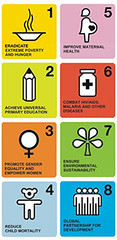
Millennium Development Goals (Photo credit: jiadoldol)
A lot of people are now questioning the ’economic model’ the world uses. Our governments prioritise the mantra of unlimited economic growth. But this approach doesn’t take the environment into consideration. So why is the economy more important than people or the environment? The economy exists to facilitate people’s wellbeing and to ensure that this beautiful planet is here for generations to come. An economic model that drives the destruction of the natural world at an ever-accelerating rate – to the benefit of a very small global elite – is obviously not working.
This often comes down to the values we hold as a society – both in different countries and as a global society. Most of us will share a common understanding of what is good, what we care about, however, when it comes to global discussions and agreements, the planet takes second place to the needs of each individual country and its economic desires.
So, how can globalisation be made to work better? WWF, for example has been doing a lot of work on certification of some key traded commodities – like beef, sugar, and soy – to improve the way they’re produced and managed. They bring together industry, government, and civil society organisations to work out how better regulation and increased transparency can change this, as well as creating certification schemes in forestry and fisheries – to set standards, raise awareness, and help the public make better informed choices.
In any trade-off between the environment and people, one probably has to put people first. We here in the North, although caring deeply about nature, have no right to decide that other peoples’ lives are worth any less than those of, say, our own families or friends. The global nature of the problems we face means that so often the factors driving environmental damage in developing countries are our own consumption patterns here in the global north, including the UK.
2015 is going to be a big year. It’s the year that the Millennium Development Goals (MDGs) run out, it’s also the year the United Nations (UN) climate talks are aiming to sign a global deal. Climate change threatens poverty reduction – the environmental impacts are often felt first and hardest by poor and vulnerable communities (who actually have contributed the least in carbon emissions and other global greenhouse gases in the first place), and the majority of that burden is carried by women and girls. But environment is about much more than climate change – biodiversity loss and the ability of ecosystems to regulate and regenerate are as much of an issue.
Decisions made in the interest of development should not be undermined by other policy decisions, such as trade or agriculture.
The environment is, in fact, linked to and part of trade, economy, agriculture, food, nutrition, health, education, climate change, conflict, peace, security, gender rights and more.
Related articles